
Ten Tors is extremely popular, and we often find that we are oversubscribed and have to make decisions about who can take part through the year. This page is intended to explain how that happens as transparently as possible so that everybody knows where they stand.
There are three times in each training season where we have to limit numbers. In reverse order, these are:
Ten Tors event (May) – the Army impose a strict limit of 6 people per team (no more, no less). There is also a cap on the total number of teams in the event and a lot of competition for team entries, so it is pretty much impossible for us to enter any more teams than we are initially allocated. This is the ultimate cap on how many people can take part.
Dartmoor training (February) – as we move from local day hikes into Dartmoor training, Scout Association safety rules limit group sizes. At this point, we have to cap our numbers at 7 per team for our 35-mile teams (who will always be accompanied by at least one adult), and 8 per team for the older groups.
Initial recruitment (October) – we will start training with as many people as we reasonably can, bearing in mind the constraints above. We will aim for 9 people in each 35-mile team (ideally 6 new participants and 3 who have taken part before). Depending on numbers, we will aim to accept everybody who applies for 45- and 55-mile training at this stage (this is easier to manage because they are not accompanied by adults during training hikes).
Selection Criteria
We know that not everybody who starts training will want to carry on. Every year, people choose to withdraw from training, which is absolutely fine. What we can’t predict is how many people will drop out and when, which varies every year. That means that at each stage we may have to make selections to decide who can continue. The criteria vary slightly between initial recruitment and ongoing selections through the year.
Initial Recruitment
We split applicants into three categories (see below for more detail on age groups and distances):
- First-time 35-mile applicants
- Returning 35-mile applicants
- 45/55-mile applicants
Where we are oversubscribed in any category, we will offer priority places to:
- applicants whose parents or guardians volunteer in any capacity within Cabot District
- older year groups within each category where relevant – this is on the basis that younger year groups will have another opportunity in the future, whereas older ones may not.
Ongoing Selections
Once training has started, priority groups no longer apply and everybody is treated equally. If we have to make selections going into Dartmoor training or for the event, they will be based on the following criteria:
Attendance and completion of training – we monitor who has attended and completed each training hike. Put simply, the more training you attend and the more hikes you complete, the better your chance of being selected. It isn’t a simple black-and-white decision. Missing one day’s training will not usually rule you out of selection, but we have had situations where that is the only thing to choose between people.
In particular, the Army have a minimum requirement that everybody has completed 4 days of Dartmoor training. We have 3 weekends (6 days) in our training programme. If you miss one weekend and we then end up having to cancel a day due to bad weather, or if you get injured, you will automatically fall below the 4-day minimum and not be able to take part.
Attitudes and behaviour – we set clear expectations of the attitudes and behaviour that we want to see (see below) and collect feedback from leaders throughout the training season on how people perform against them. People receiving positive feedback are more likely to be selected. Those receiving negative feedback are less likely to be selected.
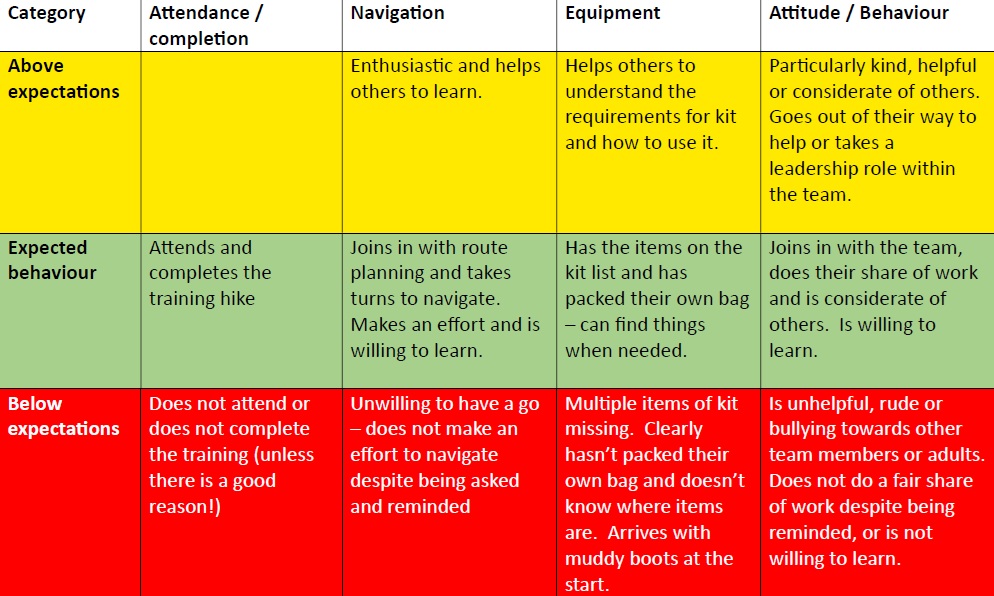
Ultimately, how we apply these criteria is a matter of judgment made by experienced leaders. The situation and numbers that we deal with are different every year, and we can’t reduce it to a straightforward mathematical formula.
Tie-Breaks
Where these criteria do not produce a clear outcome we may need to make final selections by drawing names at random. In this case, anybody who has been unlucky and missed out in previous years due to a random draw will not be included in a draw again – you won’t be unlucky twice!
Age Groups and Distances
Ten Tors has 35, 45, and 55-mile categories. The Army’s rules dictate who can enter each one based on school year groups. This is how we apply those rules to our Cabot teams.
• Year 9 – you will be in a 35-mile team.
• Year 10 – you will be allocated initially to a 35-mile team. If you completed Ten Tors in year 9, there may be an option to move up to 45-miles if we have spaces available, but we can’t guarantee this. Most year 10s end up taking part at 35 miles.
• Year 11 – you will be in a 45-mile team.
• Year 12 – you will be initially allocated to a 45-mile team, with the option to do 55 miles if you have completed Ten Tors before. Priority for 55 miles will go to older year groups, but there is often space for year 12s to do 55 if they want to.
• Year 13 and above – you will be in a 55-mile team